[Case 04]
Designing a Patient Experience That Balances Compliance and Care
Healthcare / Pharmaceutical
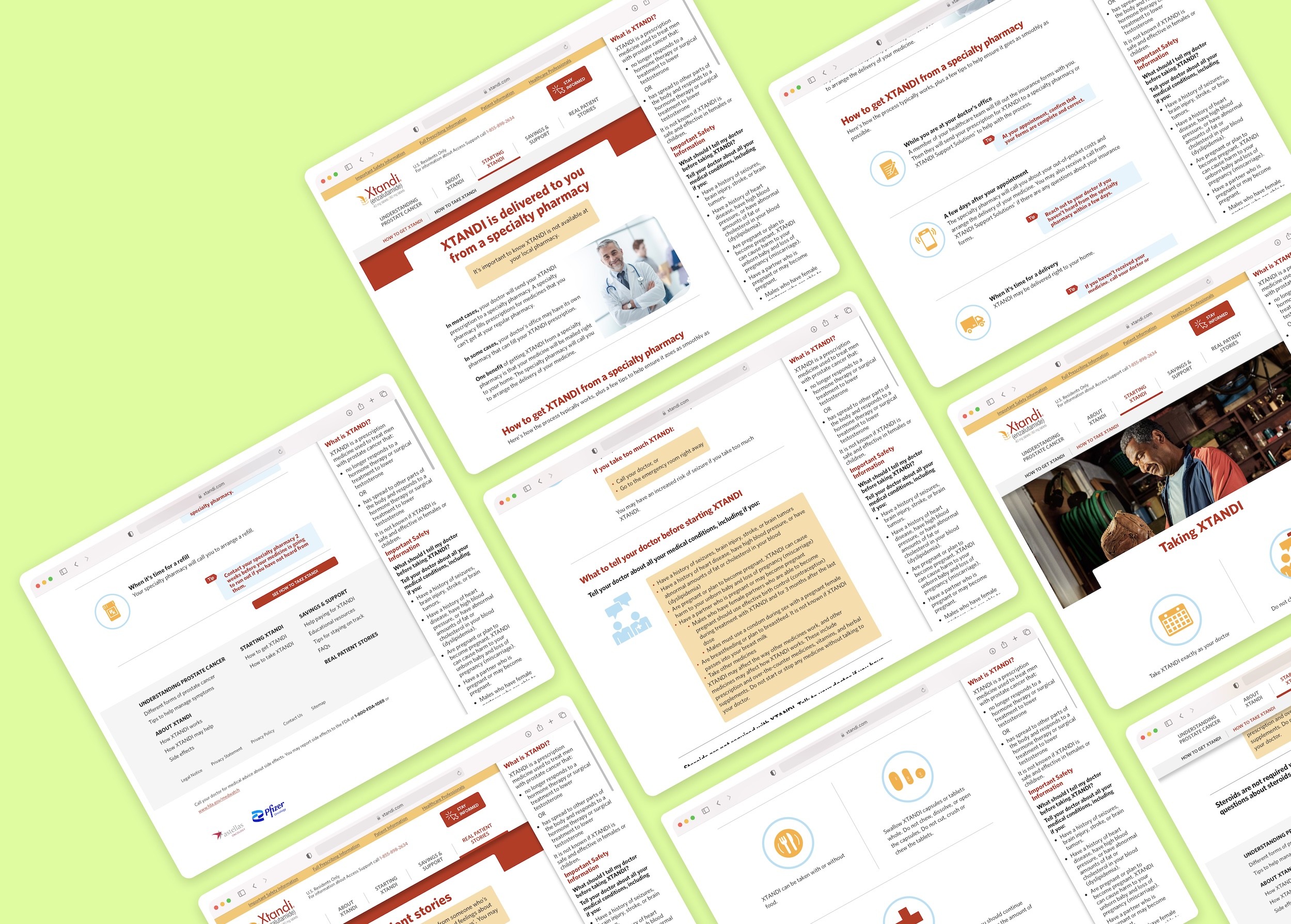
XTANDI Patient Desktop & Mobile Revamp
Enhancing Compliance, SEO, and Patient Support for a Global Audience
[Project Overview]
Partnered with the Xtandi marketing team to revamp their patient website across mobile and desktop, ensuring FDA compliance, updating content, and enhancing educational resources. Delivered a patient-centric digital experience through UX/UI design, user testing, journey mapping, multilingual support, and SEO improvements—now live on XTANDI.com.
[Problem Statement]
Following Xtandi’s FDA approval for treating Metastatic Castration-Sensitive Prostate Cancer (mCSPC), the brand faced regulatory requirements to remove all “new” language from its communications within six months. The existing website also lacked adequate multilingual support and SEO optimization, limiting its reach and effectiveness for patients and caregivers. Additionally, content from former brand ambassadors Dennis and Theresa needed to be removed or replaced. The challenge was to ensure regulatory compliance, provide accessible educational resources in Spanish and Mandarin, and optimize site structure and content for SEO—all while maintaining the established Xtandi brand look and feel.
[Industry]
Healthcare / Pharmaceutical
[My Role]
Lead Designer
[Platforms]
Desktop, Mobile, Print
[Timeline]
January 2020- March 2020
[Persona]

Janice Patterson
Caregiver (Spouse)
I need clear, accurate information to support my husband’s treatment decisions, and I want to find it easily.
Age: 74
Location: Southern California
Tech Proficiency: Low
Gender: Female
[Goals]
Quickly find trustworthy information about Xtandi treatment and financial support options.
Access resources in preferred languages (Spanish or Mandarin).
Ensure content is clear, easy to navigate, and up-to-date.
[Frustrations]
Confusing site navigation and difficulty finding answers to common questions.
Lack of translated materials to support non-English speaking patients.
Outdated content that creates uncertainty about treatment information.
[Process]
[01] User Research
Conducted interviews with caregivers and patients to understand information gaps and language needs.
Analyzed site traffic and drop-off points to identify areas of friction in the user journey.
Collaborated with compliance and regulatory teams to ensure accuracy and FDA alignment.
[02] Insights
Users were confused by outdated ambassador content and required clearer guidance on treatment options.
Multilingual resources were critical for accessibility and patient education.
Adding SEO-optimized FAQs and video transcripts would improve both searchability and user comprehension.
[03 Design Solution]
Removed all outdated ambassador content (Dennis and Theresa) and replaced it with generalized educational materials.
Added FAQs and video transcripts to improve SEO and provide clear, accessible patient information.
Introduced Spanish and Mandarin translations of key resources and prescribing information to broaden reach.
[04] Testing & Iteration
Conducted usability testing with caregivers and older patients to ensure ease of navigation and comprehension.
Gathered feedback from Pfizer/Astellas internal stakeholders to confirm compliance and brand consistency.
Refined language and content hierarchy based on iterative testing and SEO analysis.
[Outcomes]
Fully compliant with FDA regulations for mCSPC-related language within the six-month mandate.
Increased engagement on the site, with more time spent on FAQs and educational resource pages.
Improved SEO performance, resulting in a 35% increase in organic search traffic within the first quarter post-launch.
[Key Learnings]